How to Fix Uneven Permanent Brows: A 2026 Guide
Table of Contents
- Why Permanent Brows Heal Uneven and How to Tell
- How Long Do Permanent Brows Take to Heal?
- Permanent Makeup Eyebrow Correction: Your Professional Options
- Saline Removal for Eyebrow Tattoo: When It Helps
- Makeup to Even Out Eyebrows While You Wait
- Red Flags and Risks of Corrective Work
- How to Prepare for a Corrective Consultation
- Frequently Asked Questions
Last Updated: October 13, 2026
Why Permanent Brows Heal Uneven and How to Tell
If you have uneven permanent brows, the cause is usually swelling, uneven pigment application, or your natural brow shape showing through. Most unevenness in the first two weeks is temporary.
This guide from Wink Ink Studios walks you through how to fix uneven permanent brows at every stage.
Here is the part most people get wrong: they panic in week one.
Common Causes of Asymmetry After PMU
Permanent makeup results depend on several things. Any one of them can throw off your brow balance:
- Natural facial asymmetry you already had
- Uneven pigment application during the session
- Different healing speed on each side
- Skin type and oil production differences
Faces are not perfectly symmetrical. A good artist maps brows to work with your features, not against them. But some difference is normal and expected.
Is It True Asymmetry or Just Swelling?
Swelling is the most common reason brows look uneven in the first two weeks. One side often swells more than the other, which changes how the brow sits on your face.
Here is a quick way to check:
| Sign | Swelling (Wait) | True Asymmetry (Act) |
|---|---|---|
| Timing | Days 1-14 | After 4-6 weeks |
| Look | Puffy, raised, tender | Settled, flat, healed |
| Shape | Changes daily | Consistent for weeks |
| Color | Darker, patchy | Faded, uneven tone |
If your brows still look off after six weeks, the asymmetry is likely real and worth addressing.
How Long Do Permanent Brows Take to Heal?
Permanent brows take four to six weeks to fully heal. The color softens by up to half during that time. You cannot judge the final result until healing is complete.
That timeline matters because it decides when correction is safe. Working on brows too early can damage healing skin and make things worse.
The Four Stages of Healing and Safe Decision Points
Healing happens in four stages. Each one has its own risks and its own safe actions.
- Days 1-3: Fresh wound stage. Brows are dark, sharp, and tender. Do not touch them. No correction is safe yet.
- Days 4-14: Peeling stage. Flaking and itching start. Color looks patchy. Still no correction.
- Weeks 2-4: Ghosting stage. Pigment appears to vanish. This is normal, not a failed result. Keep waiting.
- Weeks 4-6: Settled stage. True color and shape show. This is your first safe point for assessment.
Permanent Makeup Eyebrow Correction: Your Professional Options
Permanent makeup eyebrow correction starts with a professional assessment, but the fix depends on what is actually wrong. Shape, density, and color each call for a different approach. Matching the correction to the cause is what separates a good result from another round of unevenness.
Correction Options by Cause and Severity
Use this to understand what an artist is likely to recommend:
| Cause | Typical severity | First-line option | When more is needed |
|---|---|---|---|
| Shape is off (too high, too low, wrong arch) | Mild to moderate | Brow mapping plus blending on one side | Saline removal if the shape cannot be blended away |
| Density is uneven (one brow lighter or patchier) | Mild | Touch-up pigment to the lighter brow | Second touch-up if retention is poor |
| Color is wrong (orange, red, blue-gray) | Moderate | Color correction with a neutralizing tone | Multiple sessions, sometimes removal first |
| Pigment is too dark or too saturated | Moderate to severe | Saline removal to lift, then re-pigment | Laser if saline is too slow |
| Old or migrated pigment | Severe | Removal, then a fresh shape | Full re-do after skin settles |
Mapping and Blending Techniques
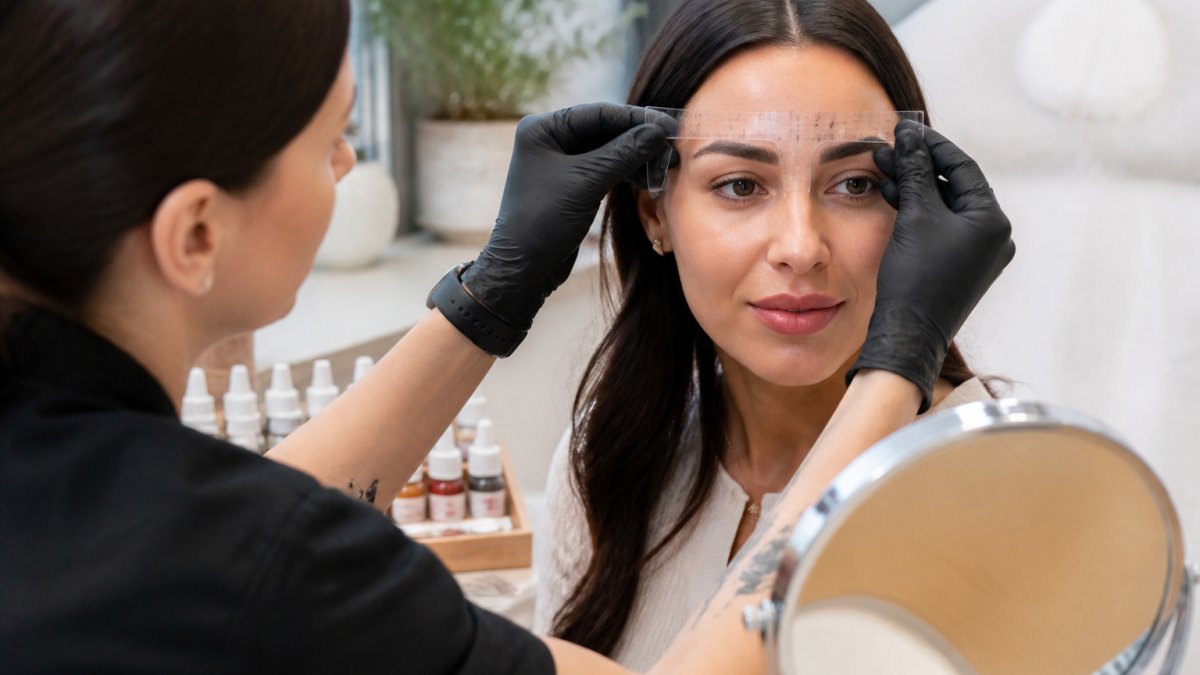
Brow mapping is the first step in almost every correction. The artist measures your face and marks where each brow should start, arch, and end. From there, blending smooths the difference between the two sides:
- Adding pigment to the thinner or lighter brow
- Softening the heavier brow with light shading
- Adjusting the arch or tail on one side only
- Using soft mapping to balance the overall shape
The goal is balance, not perfection. Chasing perfect symmetry on an asymmetric face usually looks worse, not better.
Color Correction for Unwanted Tones
Sometimes the problem is not shape but color. Healed brows can turn orange, red, or blue-gray over time.
- Orange or red tones usually come from warm pigment fading.
- Blue-gray tones often come from older pigment formulas or too-deep placement.
Color correction uses a complementary tone to neutralize the unwanted color before adding the final shade. This is skilled work. It often takes more than one session, and in severe cases the artist may recommend removal first so the new pigment sits on a cleaner base.
Touch-Ups vs. Removal vs. Waiting
Not every uneven result needs a corrective session. The decision usually comes down to three questions:
- Is it healed? If you are under four to six weeks, wait. Most unevenness at this stage is temporary.
- Is it shape, density, or color? Shape and density often respond to a touch-up. Color and over-saturation may need removal.
- Is there enough skin left? If the brow has been worked multiple times, adding more pigment may not be safe or effective.
A touch-up is the lightest option and works best on mild density or shape differences. Saline removal is slower but gentler, and it is the better choice when the shape is wrong or the color is too dark to correct with pigment alone. Waiting is a real option too, especially if the brow is still settling or if a medical red flag is present.
Saline Removal for Eyebrow Tattoo: When It Helps
Saline removal for eyebrow tattoo lifts unwanted pigment from the skin. It works best on brows that are too dark, too high, or the wrong shape. It is a gradual process, not a one-visit fix.
Here is when saline removal is generally considered:
- The brow shape is wrong and cannot be blended away
- The color is too dark to correct with pigment alone
- A previous artist placed the brow too high or too low
- You want to start fresh with a new shape
Saline removal takes multiple sessions spaced weeks apart. It is slower than laser but gentler on the skin.
Makeup to Even Out Eyebrows While You Wait
Makeup to even out eyebrows is your best tool during the healing period. It hides unevenness without touching the healing skin. The trick is to work with the brow you have, not against it.
- Use a fine brow pencil to fill only the lighter or thinner areas
- Choose a shade one step lighter than your healed pigment
- Brush brow gel upward to blend the two sides
- Add a touch of concealer above the higher brow to visually lower it
Keep makeup off your brows entirely for the first 10 to 14 days. After that, gentle application is fine.
Red Flags and Risks of Corrective Work
Corrective work carries real risks, and the first job is separating a cosmetic problem from a medical one. Uneven brows are an aesthetic issue. Infection and allergic reaction are health issues. They need different people.
Cosmetic Unevenness vs. Something That Needs a Doctor
Use this triage to decide who to call:
| What you see | What it usually means | Who to contact |
|---|---|---|
| One brow darker, patchier, or higher than the other | Normal healing or true asymmetry | Your artist, after 4-6 weeks |
| Mild redness, tenderness, or flaking in the first few days | Expected wound healing | No one, unless it worsens |
| Spreading redness, heat, or swelling after day 3-4 | Possible infection | A doctor or nurse practitioner |
| Pus, yellow crusting, or a bad smell | Possible infection | A doctor or nurse practitioner |
| Fever or chills | Possible systemic infection | Urgent care or emergency |
| Rash, hives, or blistering around the brow | Possible allergic reaction | A doctor or nurse practitioner |
| Severe pain that gets worse, not better | Possible infection or complication | A doctor or nurse practitioner |
A common pattern is that clients wait too long because they assume every symptom is part of healing. If a symptom is spreading, worsening after the first few days, or paired with fever, treat it as medical until a clinician says otherwise. Your artist cannot diagnose or prescribe.
Risks and Limits of Adding More Pigment
Correction is not risk-free. Every session adds trauma to skin that has already healed once, and more pigment means more chances for the color to shift over time.
- Scarring. Repeated passes over the same area raise the risk of hypertrophic scarring, especially on oily or previously scarred skin.
- Pigment migration. Pigment placed too deep or too often can drift, blurring the brow edge.
- Color shift. Layering warm over cool, or cool over warm, can push the healed tone toward orange, red, or blue-gray.
- Over-saturation. Adding pigment to fix density can make the brow look flat, solid, or tattooed rather than soft.
A realistic expectation is improvement, not perfection. Most practitioners find that corrective work gets you closer to balanced, but chasing perfect symmetry on an asymmetric face usually looks worse, not better. If your artist says adding pigment is not appropriate, that is a limit worth respecting, not a sales problem to solve elsewhere.
How to Prepare for a Corrective Consultation
A good consultation starts with information. Bring these to your appointment so your artist can plan the right fix:
- Photos of your brows right after the original procedure
- The date of your last session and the technique used
- Any products or aftercare you used
- A list of your questions and concerns
- Your goal for the final shape and shade
At Wink Ink Studios, every corrective consultation starts with a full assessment of your healed result.
Come with clean skin and no makeup on your brows. Skip blood thinners like aspirin for a few days before, unless your doctor says otherwise.
Uneven brows after permanent makeup can feel frustrating, but most cases have a clear fix once healing is complete.
Frequently Asked Questions
Can uneven permanent brows be corrected?
Yes, uneven permanent brows can often be corrected, but the approach depends on the cause and how healed the brows are. If asymmetry comes from swelling or incomplete healing, waiting is the first step. Once brows are fully healed (usually 4-6 weeks), a professional can use mapping, blending, touch-ups, or color correction to balance the shape. In some cases, saline removal or laser may be needed before reworking the brows. A consultation with a certified artist will determine the safest and most effective plan.
Should I wait until my permanent brows are fully healed before correcting them?
Yes, you should wait until your permanent brows are fully healed before considering correction. The healing process typically takes 4-6 weeks, and during this time the brows will go through peeling, fading, and color shifts. Making changes too early can lead to overcorrection or damage. A touch-up appointment is usually scheduled at the 6-8 week mark, which is the ideal time to assess the healed result and make any necessary adjustments.
How do professionals fix asymmetrical permanent brows?
Professionals fix asymmetrical permanent brows using a combination of techniques. They start with brow mapping to reassess the shape and identify the differences. Then they may add pigment to sparse areas, blend colors to create balance, or use color correction to neutralize unwanted tones. In some cases, saline removal or laser is used to lighten overly dark or misplaced pigment before reworking. Each correction plan is customized to the individual's skin, original pigment, and desired outcome.
Can permanent brow tattoo pigment be lightened or removed?
Yes, permanent brow tattoo pigment can be lightened or removed, but the method depends on the pigment color, depth, and your skin type. Saline removal is a popular option for fading unwanted pigment, especially for warm or orange tones. Laser removal is another option, though it may not work well on all pigment colors and carries a higher risk of scarring or paradoxical darkening. A consultation with a professional is essential to determine the safest and most effective approach for your brows.